
Reference protocol: PT-141
PT-141 (bremelanotide) is not a cycle protocol but an event protocol: it is dosed on demand, ahead of time, and its frequency limits are not a suggestion — the melanocortin system desensitizes with repeated use.
The reference for PT-141 is a 2 mg dose —20 units at 10 mg/ml— between 45 and 60 minutes before activity, preceded on a separate occasion by a 500 mcg tolerance test. The documented limits are hard: at most one injection every 24 hours and 8 doses (16 mg) per month.
First time? Follow the step-by-step guide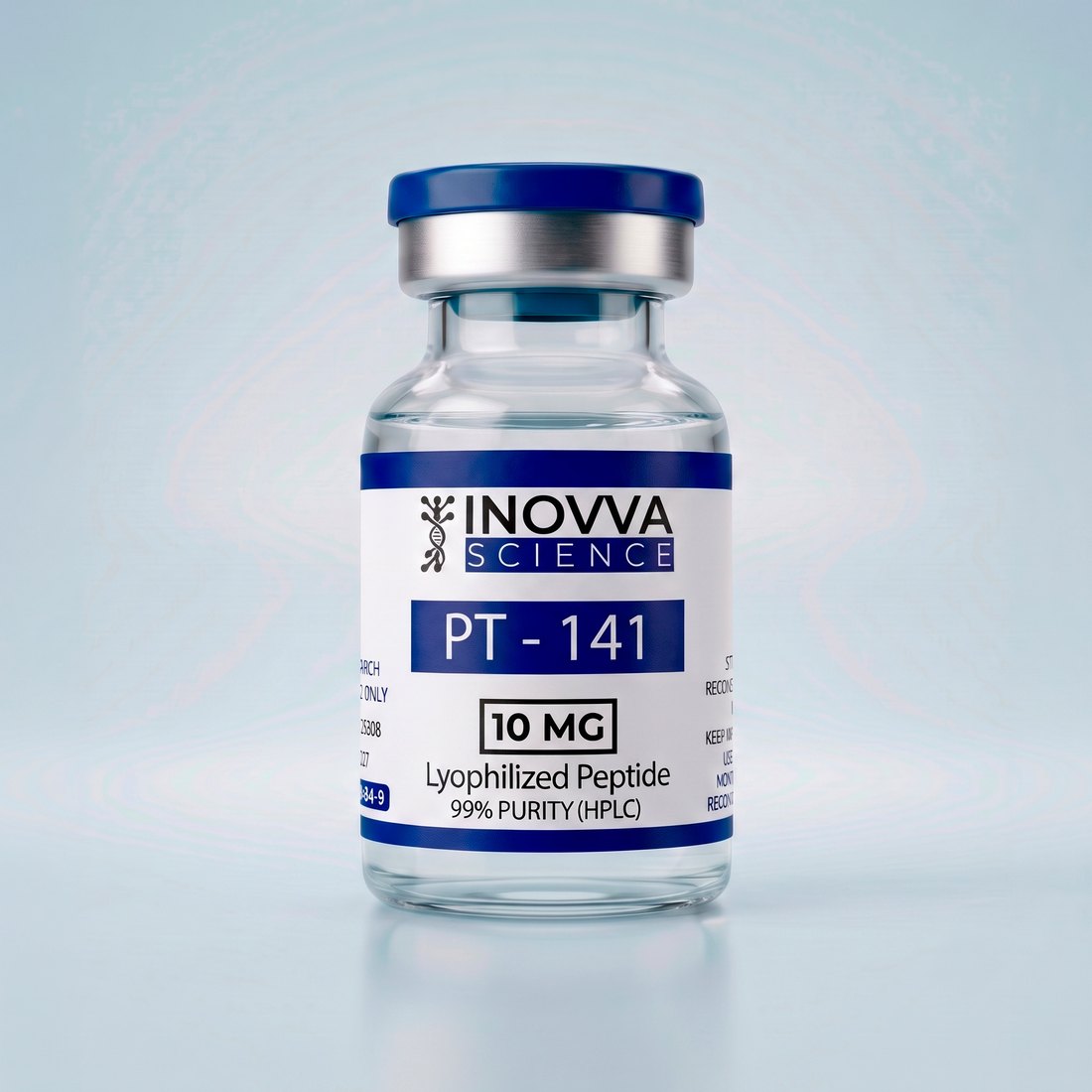 View product & buy →
First time? Start here
Your PT-141 vial arrives as a dry powder: you mix it with a special water — that step is called reconstituting — and measure each dose with an insulin syringe. Follow the steps with the numbers for your case.
Which case is yours?
500 mcg tolerance test (5 U), on an occasion with no expectation of effect.
Step 1 of 6 Get what you need
Your vial, a vial of bacteriostatic water (sold separately), a 1 ml U-100 insulin syringe — ask for it exactly like that at the pharmacy — and alcohol wipes.
Step 2 of 6 Measure the water
The 10 mg vial takes 1 ml of water: one full draw to 100 — do not repeat it. Flip off the plastic cap (the rubber stopper stays on), wipe it with alcohol and let the water run down the inside wall.
Step 3 of 6 Swirl gently, never shake
Swirl the vial slowly until it turns clear — never shake it; some take a few minutes. Then it goes in the fridge (2–8 °C) and is used within 12 weeks — the limit is mainly to keep bacteria out each time the stopper is pierced. Unmixed, keep it refrigerated from the day it arrives too.
Step 4 of 6 Fill to the 5 mark
The numbers printed on the syringe are units (U): 100 U = 1 ml. Your dose of 500 mcg is 0.05 ml — draw up to the 5 mark.
Step 5 of 6 Inject under the skin
Belly area, two fingers away from the navel: alcohol, pinch the skin, insert the full needle and inject slowly. Switch sides each time and use a new syringe.
Step 6 of 6 When to use it
Used only when you need it: 45–60 minutes before activity.
- Hard limits
- ≤1 injection per 24 h · ≤8 doses (16 mg) per month
- 500 mcg your dose test5 Uonce
- 2 mg standard20 Uif the test went well
Summary Done — you have the essentials
Your 10 mg vial covers the 500 mcg test dose and 4 doses of 2 mg.
Order or ask on WhatsApp (opens WhatsApp in a new tab)Quick dictionary — the words that stop beginners
- Reconstitute: mixing the vial's powder with the special water so it becomes a liquid you can measure.
- Bacteriostatic water: the special water for that mix (regular water will not do); sold separately — one vial covers several mixes.
- Unit (U): the insulin syringe's measure: 100 units = 1 ml. Go by the printed numbers, not by counting lines (on a 1 ml syringe each line is usually 2 U).
- U-100 syringe: the standard 1 ml insulin syringe, numbered from 0 to 100 units; sold at any pharmacy.
- mg and mcg: milligrams and micrograms: 1 mg = 1,000 mcg. Mind the factor of one thousand when reading a dose.
- Subcutaneous: an injection under the skin (not into muscle or vein), usually in the belly area.
- Cycle and washout: using the product for a period and then stopping completely for some weeks; when resuming you start again from the starting dose.
Quick facts
| Parameter | Reference |
|---|---|
| Use | On demand, per event — not a cycle compound |
| Lead time | 45–60 minutes before activity |
| First time | 500 mcg tolerance test, on one occasion with no expectation of effect |
| Standard dose | 2 mg · documented maximum 2.5 mg (only with prior tolerance) |
| Hard limits | ≤1 injection per 24 h · ≤8 doses (16 mg) per month |
| Documented route | Subcutaneous injection |
Reconstitution and syringe units
Our 10 mg vial is reconstituted with 1 ml of bacteriostatic water: it sits at 10 mg/ml.
The buttons follow the protocol's dose steps; the starting dose comes pre-selected.
Fill the syringe up to the 5 mark
The syringe: a 1 ml U-100 insulin syringe (numbered 0 to 100 U = 1 ml), sold at any pharmacy. Go by the printed numbers, not by counting lines.
It does not fit in a 1 ml syringe: split the draw in two or reconstitute with less water.
Open this calculation in the calculatorSee the full dose-to-units table
| Dose | U-100 syringe | Volume | Doses per vial |
|---|---|---|---|
| 500 mcg (test) | 5 U | 0.05 ml | 20 |
| 2 mg (standard) | 20 U | 0.2 ml | 5 |
| 2.5 mg (maximum) | 25 U | 0.25 ml | 4 |
Units refer to an insulin U-100 syringe (100 units = 1 ml). Tap a figure to open it in the calculator. The last column shows how many complete doses the vial yields.
How it is used the first time
The initial 500 mcg dose is not meant to produce an effect: it checks how you react to the compound —flushing, nausea, headache— before exposing yourself to the full dose. Do it on an occasion with no expectations. If you tolerate it well, the next one can already be the standard 2 mg, always with the 45–60 minute lead time.
The 2.5 mg maximum dose is reserved for those who have already developed tolerance to the standard dose and find it insufficient. Beyond that there is no documented margin.
Effects and warning signs
- The most common: nausea —the most frequent in the public documentation—, facial flushing and headache. They are usually mild and transient.
- Less common: vomiting, nasal congestion, dizziness, fatigue, joint pain.
- Simultaneous dizziness and blurred vision are a warning sign: seek immediate medical attention.
- Chronic use above the limits desensitizes the melanocortin system and the compound stops responding.
In our catalog
The 10 mg vial is on the PT-141 product page. If the usage pattern you need exceeds this compound's monthly limits, that is a signal to rotate, not to force it: message us on WhatsApp and we'll talk it through.
Frequently asked questions
How far in advance is it injected?
Between 45 and 60 minutes before activity: the effect of PT-141 is not immediate, it acts through the central nervous system and needs that window to set in. Injecting it at the last moment speeds nothing up.
What is the test dose for if it has no effect?
To discover your reaction to the compound —flushing, nausea, headache— with a quarter of the exposure and without ruining a real occasion. It is the difference between finding out with 500 mcg or with 2 mg on board.
How many doses does the 10 mg vial yield?
5 standard doses of 2 mg, 4 maximum doses of 2.5 mg, or 20 test doses of 500 mcg. At the documented limit of 8 doses per month, one vial lasts more than two weeks of maximum permitted use.
What happens if I use it more than 8 times a month?
The documentation is categorical: excess desensitizes the melanocortin system —the compound stops working— and the monthly maximums exist to protect health. If you need more frequency, the documented path is to rotate compounds, not to stack doses.
Reference protocols compiled from documented research practice and adapted to our formats. Research-context documentation (RUO): not medical advice, not a prescription, and no substitute for professional evaluation.