
Reference protocol: Tirzepatide
Tirzepatide is a dual GIP/GLP-1 agonist dosed weekly. Its reference protocol is the most standardized in the class: a fixed six-step ladder where the rule is not how much to increase, but how long to wait before doing so.
The tirzepatide reference starts at 2.5 mg weekly —25 units at 10 mg/ml— and holds each dose for a minimum of 4 weeks before moving up to the next step: 2.5 → 5 → 7.5 → 10 → 12.5 → 15 mg. Our 20 mg vial is reconstituted with 2 ml.
First time? Follow the step-by-step guide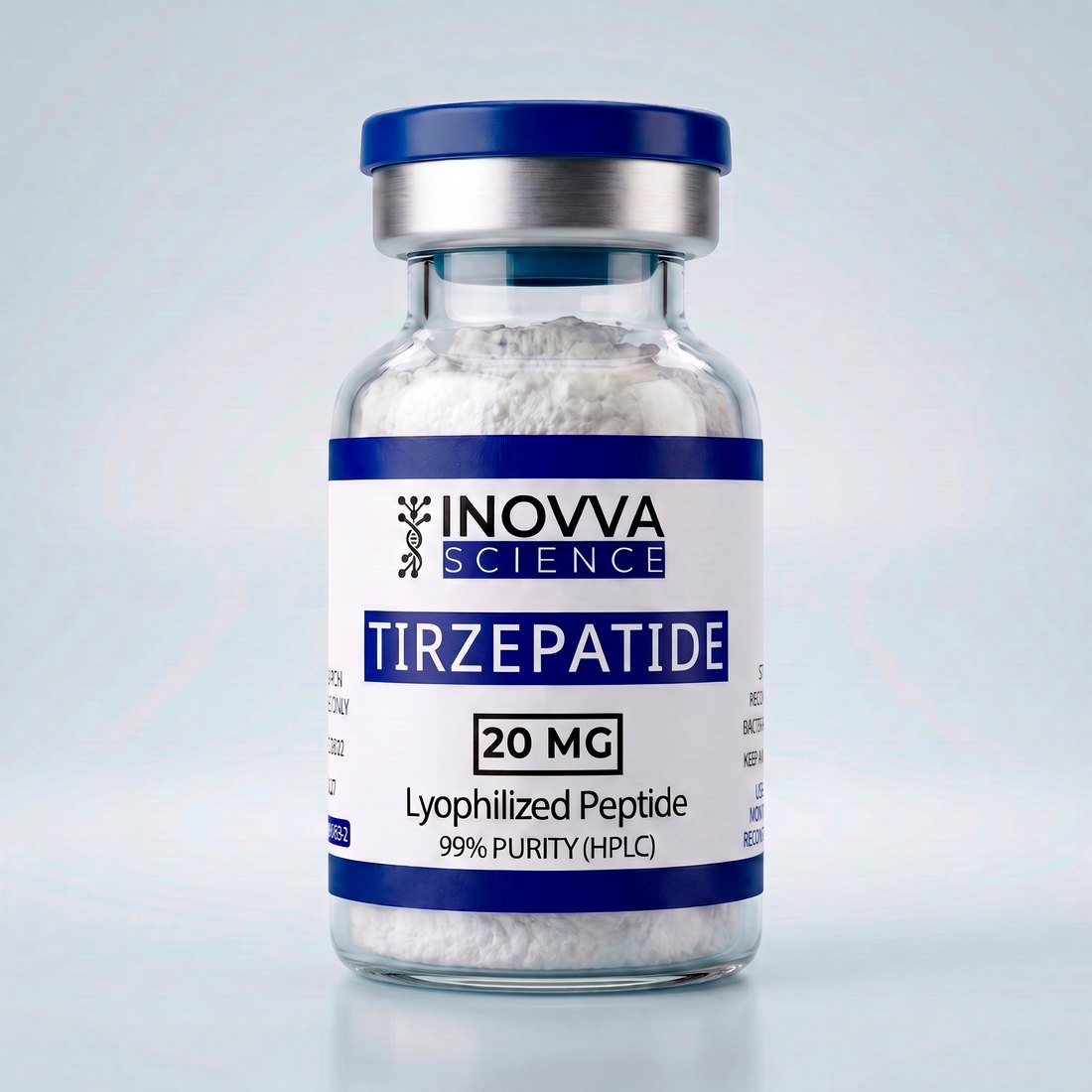 View product & buy →
First time? Start here
Your Tirzepatide vial arrives as a dry powder: you mix it with a special water — that step is called reconstituting — and measure each dose with an insulin syringe. Follow the steps with the numbers for your case.
Which case is yours?
No prior experience with this class: start at 2.5 mg and stay there 4 weeks.
Step 1 of 6 Get what you need
Your vial, a vial of bacteriostatic water (sold separately), a 1 ml U-100 insulin syringe — ask for it exactly like that at the pharmacy — and alcohol wipes.
Step 2 of 6 Measure the water
The 20 mg vial takes 2 ml of water: 2 full draws to 100. Flip off the plastic cap (the rubber stopper stays on), wipe it with alcohol and let the water run down the inside wall.
Step 3 of 6 Swirl gently, never shake
Swirl the vial slowly until it turns clear — never shake it; some take a few minutes. Then it goes in the fridge (2–8 °C) and is used within 12 weeks — the limit is mainly to keep bacteria out each time the stopper is pierced. Unmixed, keep it refrigerated from the day it arrives too.
Step 4 of 6 Fill to the 25 mark
The numbers printed on the syringe are units (U): 100 U = 1 ml. Your dose of 2.5 mg is 0.25 ml — draw up to the 25 mark.
Step 5 of 6 Inject under the skin
Belly area, two fingers away from the navel: alcohol, pinch the skin, insert the full needle and inject slowly. Switch sides each time and use a new syringe.
Step 6 of 6 Your schedule
Used once a week, always on the same day.
⚠︎ = does not fit in a 1 ml syringe at this concentration: split the draw or reconstitute with less water.
Each step: ≥ 4 weeks
- 2.5 mg your dose25 U
- 5 mg50 U
- 7.5 mg75 U
- 10 mg100 U
- 12.5 mg125 U ⚠︎
- 15 mg maintenance150 U ⚠︎
Summary Done — you have the essentials
Your 20 mg vial yields 8 complete doses of 2.5 mg (≈ 8 weeks).
Order or ask on WhatsApp (opens WhatsApp in a new tab)Quick dictionary — the words that stop beginners
- Reconstitute: mixing the vial's powder with the special water so it becomes a liquid you can measure.
- Bacteriostatic water: the special water for that mix (regular water will not do); sold separately — one vial covers several mixes.
- Unit (U): the insulin syringe's measure: 100 units = 1 ml. Go by the printed numbers, not by counting lines (on a 1 ml syringe each line is usually 2 U).
- U-100 syringe: the standard 1 ml insulin syringe, numbered from 0 to 100 units; sold at any pharmacy.
- mg and mcg: milligrams and micrograms: 1 mg = 1,000 mcg. Mind the factor of one thousand when reading a dose.
- Subcutaneous: an injection under the skin (not into muscle or vein), usually in the belly area.
- Cycle and washout: using the product for a period and then stopping completely for some weeks; when resuming you start again from the starting dose.
Quick facts
| Parameter | Reference |
|---|---|
| Frequency | 1 dose every 7 days, always on the same day of the week |
| Time of day | Any time, day or night |
| Fasting | Not required |
| Time per step | Minimum 4 weeks before moving up |
| Starting dose | 2.5 mg (no prior GLP experience) · 5 mg (≥1 month of prior GLP use) |
| Documented route | Subcutaneous injection |
Reconstitution and syringe units
Our 20 mg vial is reconstituted with 2 ml of bacteriostatic water: it sits at 10 mg/ml.
The buttons follow the protocol's dose steps; the starting dose comes pre-selected.
Fill the syringe up to the 25 mark
The syringe: a 1 ml U-100 insulin syringe (numbered 0 to 100 U = 1 ml), sold at any pharmacy. Go by the printed numbers, not by counting lines.
It does not fit in a 1 ml syringe: split the draw in two or reconstitute with less water.
Open this calculation in the calculatorThe protocol week
See the full dose-to-units table
| Dose | U-100 syringe | Volume | Doses per vial |
|---|---|---|---|
| 2.5 mg | 25 U | 0.25 ml | 8 |
| 5 mg | 50 U | 0.5 ml | 4 |
| 7.5 mg | 75 U | 0.75 ml | 2 |
| 10 mg | 100 U | 1 ml | 2 |
| 12.5 mg | 125 U | 1.25 ml | 1 |
| 15 mg | 150 U | 1.5 ml | 1 |
Units refer to an insulin U-100 syringe (100 units = 1 ml). Tap a figure to open it in the calculator. The last column shows how many complete doses the vial yields.
The 12.5 and 15 mg doses exceed 100 units at 10 mg/ml. For that range, reconstitute the vial with 1 ml —it comes to 20 mg/ml: 12.5 mg is 62.5 units and 15 mg is 75— or split the draw in two. Check it in the calculator.
The reference ladder
| Step | Weekly dose | Minimum time |
|---|---|---|
| 1 | 2.5 mg | 4 weeks |
| 2 | 5 mg | 4 weeks |
| 3 | 7.5 mg | 4 weeks |
| 4 | 10 mg | 4 weeks |
| 5 | 12.5 mg | 4 weeks |
| 6 | 15 mg | maintenance |
Reaching the last step is not mandatory: documented research practice stops at the dose where the response is already sufficient. Moving up without completing the 4 weeks of the previous step is the most repeated mistake with this class of compounds.
Documented precautions
- Frequent, transient adaptation effects: nausea, vomiting, diarrhea or constipation, reduced appetite, fatigue. Large, fatty meals make them worse.
- It delays gastric emptying: disclose its use before any procedure involving anesthesia (aspiration risk) and keep in mind it can alter the absorption of oral medications.
- Contraindicated with a history of medullary thyroid carcinoma or MEN-2, type 1 diabetes, diabetic retinopathy, pregnancy, and breastfeeding.
- With insulin or insulin secretagogues the risk of hypoglycemia increases; alcohol makes it worse and aggravates dehydration.
- Do not combine with other GLP agonists: receptor redundancy and desensitization.
Documented interaction with tesamorelin: opposite effects on glucose that can reduce the effectiveness of both compounds. If your line of work includes both, review the Tesamorelin protocol before combining them.
In our catalog
The 20 mg vial is on the Tirzepatide product page. As support during a caloric deficit, documented research practice combines this class with NAD+ or MOTS-c for energy and mitochondrial function, and with BPC-157 + TB-500 when digestive discomfort appears.
Frequently asked questions
How many units is 2.5 mg?
With our 20 mg vial reconstituted with 2 ml (10 mg/ml), 2.5 mg is 25 units in a U-100 syringe. The short rule at that concentration: units = micrograms ÷ 100.
How long does the 20 mg vial last?
It depends on the step: 8 complete doses of 2.5 mg (two months of the first step), 4 doses of 5 mg, or 2 doses of 10 mg. On the higher steps it pays to plan the next vial ahead of time.
Can I start at 5 mg?
The reference reserves that start for those coming from at least one month on a GLP agonist at its starting dose. After a prolonged break, the conservative approach is to resume at 2.5 mg, as if starting over: digestive tolerance is lost on discontinuation. With no prior history, the documented start is 2.5 mg.
Why wait 4 weeks per step?
Because the effect of each dose stabilizes over that period and adaptation effects cluster right after each increase. Moving up too early accumulates discomfort without information: you don't know whether the previous dose was already enough.
Reference protocols compiled from documented research practice and adapted to our formats. Research-context documentation (RUO): not medical advice, not a prescription, and no substitute for professional evaluation.