
Reference protocol: Tesamorelin
Tesamorelin is a GHRH analog and its protocol punishes impatience: the effect is cumulative, and the documentation agrees that anything under 12 weeks is wasted time. Timing matters as much as the dose.
The reference for tesamorelin is 1 mg per day —10 units at 10 mg/ml—, five consecutive days followed by two rest days, at night and at least 90 minutes after the last meal, for 12 to 16 weeks. Shorter cycles show no results in documented research practice.
First time? Follow the step-by-step guide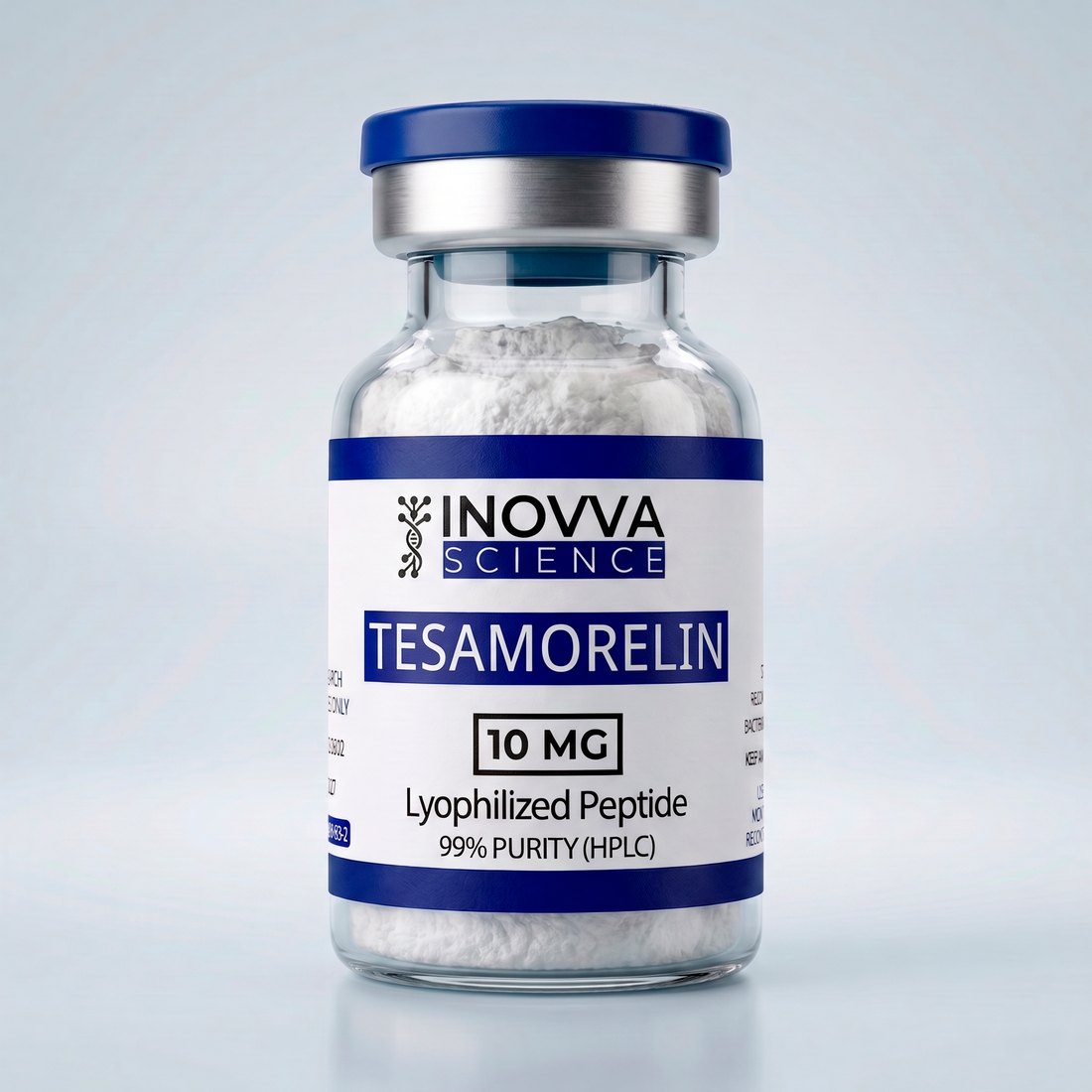 View product & buy →
First time? Start here
Your Tesamorelin vial arrives as a dry powder: you mix it with a special water — that step is called reconstituting — and measure each dose with an insulin syringe. Follow the steps with the numbers for your case.
Which case is yours?
1 mg per night (10 U) — the reference for most cases.
Step 1 of 6 Get what you need
Your vial, a vial of bacteriostatic water (sold separately), a 1 ml U-100 insulin syringe — ask for it exactly like that at the pharmacy — and alcohol wipes.
Step 2 of 6 Measure the water
The 10 mg vial takes 1 ml of water: one full draw to 100 — do not repeat it. Flip off the plastic cap (the rubber stopper stays on), wipe it with alcohol and let the water run down the inside wall.
Step 3 of 6 Swirl gently, never shake
Swirl the vial slowly until it turns clear — never shake it; some take a few minutes. Then it goes in the fridge (2–8 °C) and is used within 12 weeks — the limit is mainly to keep bacteria out each time the stopper is pierced. Unmixed, keep it refrigerated from the day it arrives too.
Step 4 of 6 Fill to the 10 mark
The numbers printed on the syringe are units (U): 100 U = 1 ml. Your dose of 1 mg is 0.1 ml — draw up to the 10 mark.
Step 5 of 6 Inject under the skin
Belly area, two fingers away from the navel: alcohol, pinch the skin, insert the full needle and inject slowly. Switch sides each time and use a new syringe.
Step 6 of 6 Your schedule
Used each night (5 nights on, 2 off), at least 90 minutes after eating.
- Cycle
- 12–16 weeks · 4–8 week washout
Summary Done — you have the essentials
Your 10 mg vial yields 10 complete doses of 1 mg (≈ 2 weeks).
Order or ask on WhatsApp (opens WhatsApp in a new tab)Quick dictionary — the words that stop beginners
- Reconstitute: mixing the vial's powder with the special water so it becomes a liquid you can measure.
- Bacteriostatic water: the special water for that mix (regular water will not do); sold separately — one vial covers several mixes.
- Unit (U): the insulin syringe's measure: 100 units = 1 ml. Go by the printed numbers, not by counting lines (on a 1 ml syringe each line is usually 2 U).
- U-100 syringe: the standard 1 ml insulin syringe, numbered from 0 to 100 units; sold at any pharmacy.
- mg and mcg: milligrams and micrograms: 1 mg = 1,000 mcg. Mind the factor of one thousand when reading a dose.
- Subcutaneous: an injection under the skin (not into muscle or vein), usually in the belly area.
- Cycle and washout: using the product for a period and then stopping completely for some weeks; when resuming you start again from the starting dose.
Quick facts
| Parameter | Reference |
|---|---|
| Frequency | 1 daily dose, 5 consecutive days + 2 rest days |
| Time of day | At night, ≥90 minutes after the last meal |
| Dose | Standard 1 mg · documented maximum 2 mg |
| Cycle | 12–16 weeks · 4–8 week washout |
| Documented route | Subcutaneous injection |
Reconstitution and syringe units
Our 10 mg vial is reconstituted with 1 ml of bacteriostatic water: it sits at 10 mg/ml.
The buttons follow the protocol's dose steps; the starting dose comes pre-selected.
Fill the syringe up to the 10 mark
The syringe: a 1 ml U-100 insulin syringe (numbered 0 to 100 U = 1 ml), sold at any pharmacy. Go by the printed numbers, not by counting lines.
It does not fit in a 1 ml syringe: split the draw in two or reconstitute with less water.
Open this calculation in the calculatorThe protocol week
Timing is part of the protocol
The dose goes at night because the growth hormone pulse it stimulates occurs during sleep, and on an empty stomach because recent food —carbohydrates and fats in particular— blunts that release. Hence the minimum of 90 minutes after the last meal.
The reference week is five consecutive dosing days and two rest days, always the same ones. The rest is not optional: it is part of the documented pattern.
Documented precautions
- Reported effects: injection-site irritation, muscle pain, headache, fluid retention, carpal tunnel symptoms.
- It can raise glucose: monitoring is advised in profiles with insulin resistance or type 2 diabetes risk.
- Contraindicated with a history of pituitary tumors or pituitary surgery, active malignancy, mannitol allergy, pregnancy, and breastfeeding.
Documented interaction with tirzepatide: tesamorelin tends to raise glucose and tirzepatide to lower it; combining them produces unpredictable control and can reduce the efficacy of both. Review the Tirzepatide protocol if you work with both.
In our catalog
The 10 mg vial is on the Tesamorelin product page. In documented research practice it is combined with Ipamorelin + CJC-1295 for synergistic GH elevation, with GHK-Cu in aesthetic lines, and with MOTS-c in metabolism.
Frequently asked questions
How far does the 10 mg vial go?
10 complete doses of 1 mg —two weeks of the standard 5-day protocol— or 5 doses of 2 mg. A full 12-week cycle at 1 mg daily requires 6 vials.
Why at night and on an empty stomach?
The growth hormone pulse that tesamorelin stimulates occurs during sleep, and recent food blunts it. Dosing at night, at least 90 minutes after eating, respects both conditions.
Is a 4-week cycle useful as a trial?
The documentation agrees that it is not: tesamorelin's effect is cumulative, and cycles under 12 weeks show no tangible results. Starting this compound means committing to the full cycle.
What do I do if the vial gels during reconstitution?
Do not shake it or force it with heat. Let it rest and swirl it gently; if the gel or clumps persist, message us on WhatsApp with a photo before using it and we will review it with you.
Reference protocols compiled from documented research practice and adapted to our formats. Research-context documentation (RUO): not medical advice, not a prescription, and no substitute for professional evaluation.